
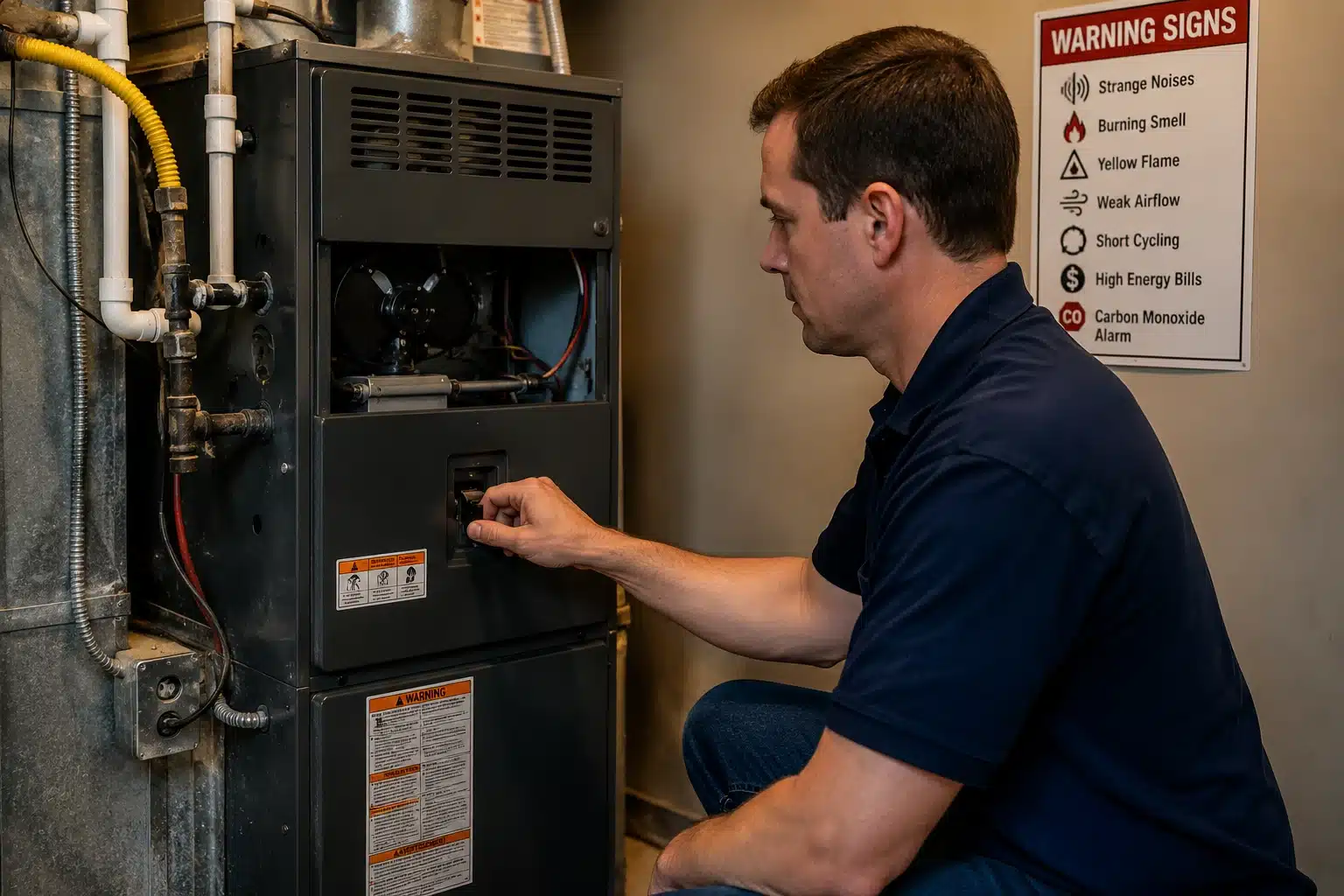
Turn the furnace off the moment you smell gas or hear a carbon monoxide detector. Same for any flame visible outside the burner compartment. Those are the ones where you shut it down first and diagnose later, from outside the house if the gas smell is strong.
The rest of this article covers the situations that are less obvious. A furnace rarely quits in one clean break. It gives you weeks of warning through noises, smells, cold air, and odd cycling patterns that most people learn to live with. Some of those warnings mean call a technician this week. Others mean cut the power now and don’t run it again until someone has looked at it.
Below are seven signs worth acting on, sorted by how fast you need to move.
Why shutting it down matters more than it sounds
A gas furnace burns fuel a few feet from air you breathe, and it does that behind a sheet metal wall. The heat exchanger keeps combustion gases separate from the air the blower motor pushes through your ducts. Furnace ventilation carries what’s left out through the flue.
When any part of that separation fails, the failure is invisible. Carbon monoxide has no color and no smell. You can’t detect it by paying attention, which is why the detector matters more than your senses do.
That’s the reason furnace safety runs on rules instead of judgment. Some symptoms get a shutdown, no debate.
Sign 1: your carbon monoxide detector goes off
This one has no gray area. Get everyone outside, then call 911 or the gas company from outside the house. Don’t stop to open windows first and don’t try to figure out whether the alarm is real.
A carbon monoxide detector that sounds during heating season points at combustion gases entering the living space, and the furnace is the first suspect. A cracked heat exchanger does this. So does a flue blocked by a bird’s nest or a partially collapsed chimney. Once responders clear the house, a furnace technician needs to test the exchanger and the venting before that unit runs again.
If your detectors are older than about seven years, replace them. The sensors degrade whether or not the unit still chirps for a battery. Put one on every floor and one near the bedrooms.
Headaches or nausea that improve when you leave the house point the same direction even without an alarm. Take that seriously.
Sign 2: the furnace smells like gas
Natural gas has no odor of its own. Utilities add mercaptan so it smells like rotten eggs or sulfur, and that smell is the whole warning system.
If your furnace smells like gas, leave. Don’t flip switches and don’t use the garage door opener on the way out. Any spark can ignite an accumulated gas leak. Call the gas company from a neighbor’s house or from the street.
A faint sulfur smell right at the furnace when it lights, gone within seconds, is a different situation and usually points at a delayed ignition or a small leak at a fitting. Still a call. Just not an evacuation.
Sign 3: a burning smell that isn’t dust
Every furnace smells like burning dust the first time it runs in October. That smell burns off in a few hours and it means the summer’s accumulation is cooking off the heat exchanger.
An electrical burning smell is different. It’s sharp, it smells like hot plastic or ozone, and it doesn’t fade. That smell comes from overheating windings in the blower motor, a failing capacitor, scorched wire insulation, or a loose connection arcing at a terminal. Shut the furnace off at the breaker and leave it off.
A burning smell from the furnace that smells like hot metal usually means the unit is overheating, and overheating almost always traces back to restricted airflow. A blocked air filter starves the blower, heat builds inside the cabinet, and the limit switch starts cutting the burners. Run that long enough and you crack the heat exchanger.
Sign 4: it’s making noises it didn’t make last winter
Furnaces hum and click. The click of the gas valve and the steady drone of the blower are both normal, and so is the whoosh at ignition. Anything sharper is worth attention.
Banging or booming at startup
Delayed ignition. Gas accumulates in the burner chamber for a second or two before it lights, and when it lights, it lights all at once. That small explosion stresses the heat exchanger every time it happens. Dirty burners cause it. So does low gas pressure.
Turn the furnace off and schedule furnace repair. This is one that gets worse and takes the exchanger with it.
Screeching or squealing
Bearings in the blower motor, or a belt on older units. A screech that shows up when the blower starts and holds steady means the motor is failing. Running it to the end usually means a seized motor and a burned winding, which turns a motor replacement into a bigger bill.
Rattling and vibration
Loose panels and duct connections, most of the time. Harmless and annoying. But a rattle that started recently, especially a metallic one that changes with blower speed, can be a cracked heat exchanger expanding as it heats. That one gets inspected.
Clicking with no ignition
Repeated clicking with no flame is the igniter or the flame sensor. The flame sensor is a thin metal rod that sits in the burner flame and confirms the fire is actually lit. When it oxidizes, it stops sensing, and the control board shuts the gas valve as a safety measure. The furnace tries again, fails again, and eventually locks out.
That one is a common and inexpensive fix. Cleaning or replacing a flame sensor is routine work.
Sign 5: the furnace is blowing cold air
Furnace blowing cold air means the blower is running while the burners are not. There are a few reasons, and they don’t all carry the same weight.
The mild version is a thermostat malfunction, or a thermostat set to “on” instead of “auto,” which runs the fan continuously between heating cycles. Check that first. It costs nothing.
The next version is a dirty flame sensor or a failed igniter, where the furnace tries to light, fails, and the blower purges the chamber with room temperature air. You’ll usually hear the click and the whoosh of the inducer before the cold air starts.
The version that matters most is a limit switch shutting the burners down because the unit is overheating. The blower keeps running to cool the heat exchanger while the gas stays off. That’s the furnace protecting itself from a real problem, usually restricted airflow from a dirty furnace filter or closed vents. Fix the airflow, and check the filter before you call anyone.
Cold air with no heat at all, plus a hot cabinet, means shut it down and call.
Sign 6: furnace short cycling
Furnace short cycling means the burners fire, run for a few minutes, shut off, and start again. If your furnace keeps turning on and off every five minutes, the unit never reaches a full heating cycle and your energy bill climbs while the house stays cold.
A dirty furnace filter is the most common cause. Airflow drops, cabinet temperature rises, the high limit switch opens, and the burners stop. Air cools, the switch closes, the burners fire again. That loop repeats until someone changes the filter.
Other causes include a thermostat installed in a bad spot (above a supply register, or in direct afternoon sun), a failing flame sensor that drops out mid-cycle, a clogged condensate line on a high efficiency unit, and an oversized furnace that satisfies the thermostat before the house has evened out.
Short cycling doesn’t require an emergency shutdown, but it does wear the igniter and the blower motor faster than normal running. Change the filter. If it continues, book a heating system inspection.
Sign 7: the furnace won’t turn off
A furnace that will not turn off with the thermostat is stuck in a call for heat, and the two usual causes sit at opposite ends of the system.
A thermostat malfunction is the easy one. Stuck contacts, a shorted wire between the thermostat and the control board, or a dead battery holding the circuit closed. Pull the thermostat off its base and the call should drop. If the furnace keeps burning, the fault is downstream.
The one that concerns me is a stuck gas valve or a welded relay on the control board. Now the furnace burns with no thermostat control, and the only thing stopping it is the high limit switch. Shut the furnace off at the breaker and close the gas valve if you can reach it safely. Then call.
Separately, a blower that runs continuously after the burners stop is usually a stuck fan limit switch or a fan setting left on. Uncomfortable, though not dangerous.
How to turn off your furnace
Knowing how to turn off a furnace before you need to is worth five minutes on a Saturday. Find these three things now and show whoever else lives with you.
1. The furnace switch. It looks like a standard light switch, mounted on or near the furnace, sometimes at the top of basement stairs. Flip it down. That kills the unit.
2. The breaker. Open the panel and find the one labeled furnace or heating. Switch it fully off. Use this if the furnace switch does nothing or you smell anything electrical.
3. The gas shutoff. A valve on the gas line running to the furnace, usually within a few feet of it. When the handle runs parallel to the pipe, gas flows. Give it a quarter turn so it sits perpendicular to the pipe and the gas is off.
If you smell gas strongly, skip all of this and leave the house. Shutting off a valve is not worth standing in a room filling with gas.
The main gas shutoff for the whole house sits at the meter outside and needs a wrench. Keep one near the meter if your area has earthquake risk.

What you can check before calling
Some furnace troubleshooting is safe to do yourself, and it resolves a real share of calls.
Look at the filter first. Hold it up to a light. If light doesn’t pass through, replace it. A blocked air filter is behind more furnace problems than any other single cause, and it’s the cheapest thing in the system.
Check the thermostat next. Confirm it’s set to heat, the target temperature is above the room temperature, and the fan is on auto. Replace the batteries. It sounds too simple to matter and it fixes calls every winter.
Check that supply and return registers are open and clear of furniture. Closing vents in unused rooms raises static pressure in the ducts and causes the same restricted airflow a dirty filter does.
Look at the furnace status light through the inspection window. Most units flash a diagnostic code, and the legend is printed on the inside of the panel door. Write the pattern down before you call. It saves the technician time and saves you money.
Then stop. Anything involving the gas valve, the burners, the heat exchanger, or the wiring belongs to someone with a combustion analyzer and a manometer.
Repair or replace
A furnace not working properly in year eight is a repair. The same furnace malfunction in year twenty is a conversation.
Age is the first filter. Most gas furnaces run 15 to 20 years, and past that, parts get harder to source and efficiency lags well behind current equipment. A cracked heat exchanger on an out of warranty furnace is usually the end, because the exchanger is the most expensive component in the box and replacing it on an old unit rarely makes financial sense.
Repeat calls are the second filter. Two or three repairs in one season on the same unit means you’re funding a replacement in installments.
There’s also comfort. If some rooms never get warm and the furnace runs constantly, the problem might be duct design rather than the furnace, and a heating system inspection will tell you which. Replacing the furnace alone won’t fix a duct problem.
Getting help in Sacramento
Sacramento winters are mild, and that’s the trap. Furnaces here sit idle from April to November, then get asked to run through a string of 35 degree nights in January. Dust settles on the heat exchanger while the flame sensor oxidizes quietly, and rodents get into the cabinet. Most furnace failures in this area show up in the first two weeks of real cold, when every furnace technician near you is already booked.
Schedule the inspection in October. It’s the cheapest insurance in home ownership.
Clarke & Rush handles furnace service in Sacramento, CA, including the safety testing that matters most on these calls, which is heat exchanger inspection and flue verification. When a unit reaches the end, we handle furnace replacement in Sacramento as well, and we’ll tell you plainly when a repair is the better call.
If your furnace is making strange noises, blowing cold air, or short cycling, call (916) 609-2665. For a gas smell, call the gas company or 911 first.
Frequently asked questions
Yes, if the alternative is running a furnace you don’t trust. Sacramento rarely drops below freezing, so a night without heat is uncomfortable rather than dangerous for a healthy adult in a normal house. Use space heaters carefully, keep them away from bedding and curtains, and never use an oven or a grill for heat. Pipes are the real concern in colder climates, and if temperatures will sit below freezing for more than a few hours, let a faucet drip and open cabinet doors under sinks.
You usually can’t confirm it yourself, which is exactly the problem. The signs that suggest it are a carbon monoxide detector alarm, a flame that flickers or rolls out when the blower starts, soot around the burner area, a strong chemical or formaldehyde smell during operation, and unexplained headaches in the house during heating season. Confirming it takes a technician with a camera scope and a combustion analyzer. A cracked heat exchanger is the one furnace problem where the correct move is shutting the unit down and leaving it down.
Not immediately, though it’s telling you something. A furnace that turns on and off frequently is usually overheating from restricted airflow and shutting itself down on the high limit switch. That switch is a safety device doing its job. The danger builds over time, because repeated overheating stresses the heat exchanger and can crack it. Change the filter first. If the cycling continues after a fresh filter and open vents, book a service call rather than waiting it out.
Dust that settled on the heat exchanger over the summer is burning off. It’s normal, it happens the first run of the season, and it should clear within a couple of hours. Open a window and let it air out. If the smell lasts more than a day, smells like hot plastic or electrical insulation, or shows up in the middle of the season instead of at the start, shut the furnace off at the breaker and have it looked at.
Power first, gas second, and gas only if the situation involves fuel. Cutting the electrical supply at the switch or the breaker stops the ignition sequence and the blower, which handles almost every mechanical or electrical failure. Close the gas valve on top of that when the furnace will not shut off on its own, when you smell a faint gas odor at the unit, or when a technician tells you to. If the gas smell is strong anywhere in the house, leave immediately and call from outside.
