
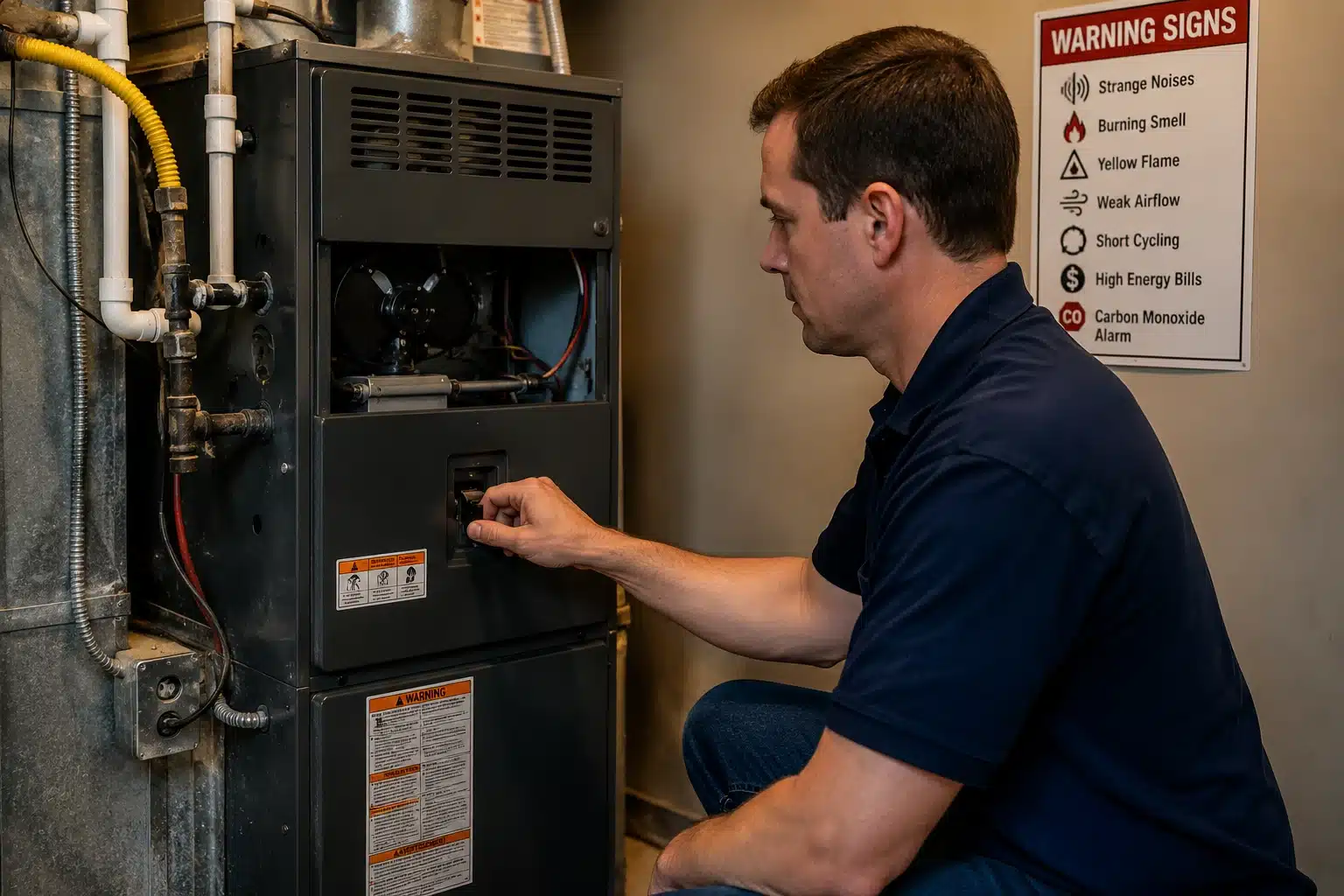
Quick Answer: A furnace that runs normally but still leaves the house cold, or one room consistently colder than the rest, often points to the ductwork rather than the furnace itself. Leaks, loose connections, crushed sections, or poor duct design can let heated air escape before it reaches your rooms. Look for uneven room temperatures, rising heating bills with no clear cause, weak airflow from specific vents, and new whistling or rattling sounds. What looks like furnace failure is often a duct problem, and it’s a much cheaper fix than a new furnace.
A bedroom that’s always colder than the rest of the house usually isn’t bad luck or a quirk of that room’s layout. It can be a sign that there is a problem with the duct work leading to that room, even while the furnace itself is running exactly as it should.
This often becomes more obvious once the heating system starts running daily through fall and winter. Before assuming you need a new furnace, it’s worth checking how well the whole system, not just the furnace, is actually working.
Symptom vs. Root Cause Quick Reference
| Symptom | Likely Root Cause |
| One room stays cold while the rest of the house is comfortable | Leaky, loose, or disconnected duct section serving that room |
| Heating bill rises with no clear change in habits | Air escaping through gaps before it reaches the rooms |
| Weak airflow from one or two specific vents | Crushed, blocked, or loose duct along that path |
| New whistling sound during operation | Air forcing through a gap or restriction |
| New rattling sound during operation | Loose metal duct or connection vibrating |
| Visible gaps, crushed sections, or missing insulation | Physical duct damage |
| More dust collecting near certain vents | Damaged return duct pulling in attic or crawlspace debris |
Treat this table as a shortlist to bring up with an HVAC technician, not a verdict on its own. Several of these symptoms can also come from a dirty filter or a poorly placed thermostat, which is why a proper check covers the whole system rather than jumping straight to the ducts.
Why Duct Problems Can Feel Like Furnace Problems
At the risk of being too basic: Your furnace creates warm air and the duct system delivers it to the rest of the home. If the ducts are leaking or damaged, some of that heat never arrives.
A bedroom can stay chilly while the furnace itself runs normally, and the system may run longer than it should trying to satisfy a thermostat that’s reading the wrong story. ENERGY STAR lists high heating bills and rooms that are difficult to keep comfortable among the common signs of poorly performing ducts.
Replacing a furnace without checking the ductwork can mean paying for new equipment while the actual problem, air escaping before it reaches the room, stays exactly where it was.
A large share of the Sacramento area’s housing stock runs ductwork through the attic, and attic temperatures here regularly climb well past 130 degrees during summer afternoons. That heat cycle, hot in summer and cold overnight in winter, expands and contracts duct materials and connections every year. A connection that was tight when the house was built can work itself loose after enough of these cycles, and the furnace ends up taking the blame for a problem that started in the attic.
Signs You May Need Heating Duct Repair
Duct problems aren’t always easy to spot, since much of the system is hidden in attics, crawlspaces, ceilings, and walls. You’ll usually notice a comfort problem well before you see the actual damage.
Uneven Heating or Slow-Warming Rooms
The clearest sign is a home that never heats evenly. The living room feels comfortable while a bedroom stays noticeably colder, or one side of the house warms quickly while another takes far longer to catch up.
Insulation, windows, room location, and sun exposure all affect room temperature, so this isn’t automatic proof of a duct problem. But if a room has become harder to heat than it used to be, or consistently takes longer than the rest of the house to reach a comfortable temperature, that change is worth having checked. A technician can inspect the duct path serving that part of the home alongside the furnace itself.
Heating Bills Rise Without an Obvious Reason
A higher utility bill doesn’t automatically mean the furnace is failing. If heated air escapes through gaps or damaged connections, the system has to run longer to keep the house comfortable, and that extra runtime shows up on the bill.
ENERGY STAR lists high winter utility bills among the warning signs of poorly performing duct systems. If your thermostat habits haven’t changed and there’s no obvious reason for the increase, duct leakage is worth ruling in or out.
Weak Airflow From Certain Vents
Stand near a few supply vents while the system is running. One vent noticeably weaker than the others points to a problem somewhere in that specific air path, whether that’s a crushed, loose, or partially blocked duct section.
Carrier lists weak airflow and uneven temperatures between rooms among the common signs of airflow problems. Weak airflow deserves a diagnosis rather than being treated as automatic proof the furnace needs replacing. The furnace may be producing plenty of heat. The problem is getting that heat into the room.
Whistling, Rattling, or New Duct Noises
Some sound during startup and operation is normal for any heating system. A new or unusually loud noise is different, and it doesn’t always come from the furnace itself.
Whistling can happen when air forces its way through a gap, restriction, or poorly fitted section. Rattling often comes from loose metal ductwork or a connection that shifts as air passes through it. Carrier identifies both whistling and rattling as possible signs of ductwork trouble. Don’t assume every new noise is coming from the furnace. Sometimes the sound is starting several feet down the duct run.
Visible Loose or Damaged Ductwork
Some duct problems are visible if you can safely see exposed sections: a disconnected joint, torn flexible duct, a crushed section, missing insulation, or a gap between two sections.
Don’t crawl deep into an attic or a tight crawlspace just to inspect the ducts. But if exposed ductwork is easy to see from a safe location, a quick visual check can be worthwhile. ENERGY STAR recommends watching for cracks, kinks, loose supply boots, and missing insulation. If you can already see damage, it’s worth having the system checked.
More Dust Around Certain Vents
Dust comes from many sources, so noticing some around a vent doesn’t automatically mean the ductwork is damaged. Still, a noticeable change is worth mentioning during an inspection.
A damaged return duct running through an attic, crawlspace, or other dusty area can pull unwanted particles into the system. Start simple: check the furnace filter and replace it if needed. If the dust continues alongside weak airflow, uneven temperatures, or visible duct damage, have the ductwork inspected.
Why a New Furnace May Not Fix the Real Problem
Your furnace and ductwork work together as one system. The furnace can produce plenty of heat, but that heat still has to travel through the ducts and enter each room through the supply registers. Think of it like a good water pump connected to damaged piping: replacing the pump doesn’t repair a leaking pipe.
If a furnace is worn out, unsafe, or unreliable, replacement is often the right call, and our guide on furnace failure warning signs covers when that’s the case. But if warm air is escaping before it reaches your rooms, new heating equipment alone won’t solve the comfort problem.
Heating issues rarely come from a single failed part. A dirty filter can reduce airflow at the same time an aging duct connection is leaking, and a thermostat placed in a bad spot can make an existing duct problem look worse than it is. A proper diagnosis looks at the furnace, filter, thermostat, and duct system together rather than replacing one component based on a single symptom.
What Causes Ductwork to Fail?
Duct systems develop problems as they age. Connections loosen. Flexible ducts can tear, crush, or kink. Supports shift, and the insulation surrounding ductwork can become damaged or compressed.
Work done in an attic or crawlspace after the original installation, whether that’s other home repairs, insulation work, storage changes, or pest control, can also disturb ducts that were previously fine. Older systems often carry several of these problems at once.
Design matters too. Poor routing, incorrect sizing, or airflow balancing problems can affect comfort even without a visible tear or disconnection. A professional inspection can tell the difference between a simple repair and a larger design issue that needs a more involved fix.
What Does Professional HVAC Duct Repair Involve?
The exact repair depends on what a technician finds. A loose connection typically means reconnecting the section and sealing it properly. A damaged flexible duct may need a section replaced. A crushed or badly kinked duct needs to be corrected so air can move freely again. Accessible metal joints may need resealing if air is escaping around the connections, and a technician may also inspect insulation around ducts running through attics, crawlspaces, or other unconditioned space.
Good air duct repair starts by finding exactly where the system is losing airflow or failing to deliver heat, through visual inspection, airflow checks, pressure testing, or other diagnostic steps depending on the home’s layout. The goal is to fix the underlying problem rather than patch over a symptom.
It’s Not Just a Winter Problem
Duct leaks affect cooling the same way they affect heating. A duct leaking conditioned air in July costs the household the same way a leak in January does, just in the opposite direction: the system runs longer, the utility bill climbs, and a room or two never quite reaches the target temperature.
Sacramento’s long, hot cooling season means those ducts spend more months of the year working hard than they get to rest. A duct connection that loosens during a hot summer often doesn’t announce itself until the furnace kicks on for the first time that fall, which is exactly why so many of these problems get blamed on the heating system instead of the actual source.
What You Can Check Before Calling a Technician
A few simple checks are worth doing first. Confirm the thermostat is set to Heat with an appropriate target temperature. Check the furnace filter, since a dirty filter reduces airflow and can produce symptoms that look like a bigger problem. Look at your supply registers and make sure furniture, rugs, curtains, or boxes aren’t blocking them. If you have exposed ductwork that’s easy to view safely, look for obvious loose connections or crushed sections, but stay out of tight crawlspaces and unsafe attic areas.
If the furnace is running but you’re still dealing with weak airflow, uneven heat, new duct noise, or a furnace blowing cold air some of the time, schedule a professional HVAC duct inspection rather than assuming the equipment itself has failed.
Repair the Ducts or Replace Them?
Not every duct problem needs a full replacement. A damaged section or loose connection is often repairable on its own. A larger replacement makes more sense when the damage is widespread, the layout has serious design problems, or much of the system is in poor condition overall.
The condition of the materials matters more than any single rule of thumb. Leakage, accessibility, insulation, and overall design all factor into the decision. Ask the technician to show you the problem when possible. Seeing the actual condition of your ducts makes it easier to understand why a particular repair, rather than a full replacement, is or isn’t being recommended.
Get the Right Diagnosis Before Replacing Your Furnace
A cold room or a rising heating bill can make a failing furnace seem like the obvious explanation. Sometimes it is. Other times the furnace is producing heat just fine and the duct system is failing to deliver it where it needs to go.
Not every heating problem means a new furnace. A technician who checks the ducts alongside the furnace, rather than assuming the equipment is at fault, is the fastest way to find out which one you’re actually dealing with.
If your home has uneven heating, poor airflow, unusual duct noise, or rising heating bills, contact Clarke & Rush to schedule an HVAC inspection. Their team can trace the problem to its actual source and help you choose the right next step before Sacramento’s colder weather settles in.
People Also Ask
How much does duct leakage typically cost a household? The exact cost depends on how much of the duct system is leaking and where the ducts run, but leaking ducts commonly force a heating or cooling system to run noticeably longer than it should to reach the same comfort level. That extra runtime shows up directly on utility bills and adds wear to the furnace or AC over time, on top of the comfort problems in the affected rooms.
Can I seal my own ductwork? Accessible metal duct joints can sometimes be sealed with mastic sealant or foil tape as a homeowner project, but most residential ductwork runs through attics, crawlspaces, or wall cavities that are difficult and sometimes unsafe to access directly. A professional inspection can identify which leaks require someone with the right equipment and experience.
How long does ductwork typically last? Well-installed ductwork can last 20 to 30 years or longer, though connections, seals, and flexible sections tend to fail well before the metal ducting itself does. Attics that see large temperature swings, like most in the Sacramento area, tend to accelerate wear on connections and insulation compared to ducts running through more temperature-stable spaces.
Does duct repair require tearing into walls or ceilings? Not usually. Most residential ductwork runs through attics and crawlspaces rather than inside finished walls, so a typical repair doesn’t require opening drywall. A technician can usually access and repair duct sections through existing attic or crawlspace access points.
Can a dirty air filter cause the same symptoms as a duct problem? Yes. A clogged filter restricts airflow through the entire system, which can produce weak airflow, uneven room temperatures, and higher bills that look identical to duct-related symptoms. Checking and replacing the filter is one of the simplest things to rule out before assuming the ductwork itself is the cause.
Is duct cleaning the same thing as duct repair? No. Duct cleaning removes dust and debris from inside the ducts and doesn’t address leaks, loose connections, or damaged sections. A dirty duct system and a leaking duct system can produce some similar symptoms, like more dust around vents, but they require different fixes, and cleaning a leaking duct system won’t resolve the comfort or cost issues a leak is causing.
How do I know if it’s my ductwork or my thermostat causing uneven heating? A thermostat placed in a bad spot, such as near a supply vent, in direct sunlight, or above a heat source, can misread the room and cycle the system incorrectly, producing uneven comfort that looks like a duct problem. The distinguishing factor is usually location: a thermostat issue tends to affect comfort broadly, while duct-related uneven heating is usually tied to specific rooms along a specific duct run.
Should ductwork be inspected during a regular furnace tune-up? A basic visual check of accessible ductwork is a reasonable part of a seasonal furnace inspection, but a full duct evaluation, including pressure testing and a check for hidden leaks, is a more thorough process usually done as its own service when a homeowner is dealing with comfort or bill concerns rather than as a routine add-on to every furnace tune-up.
