
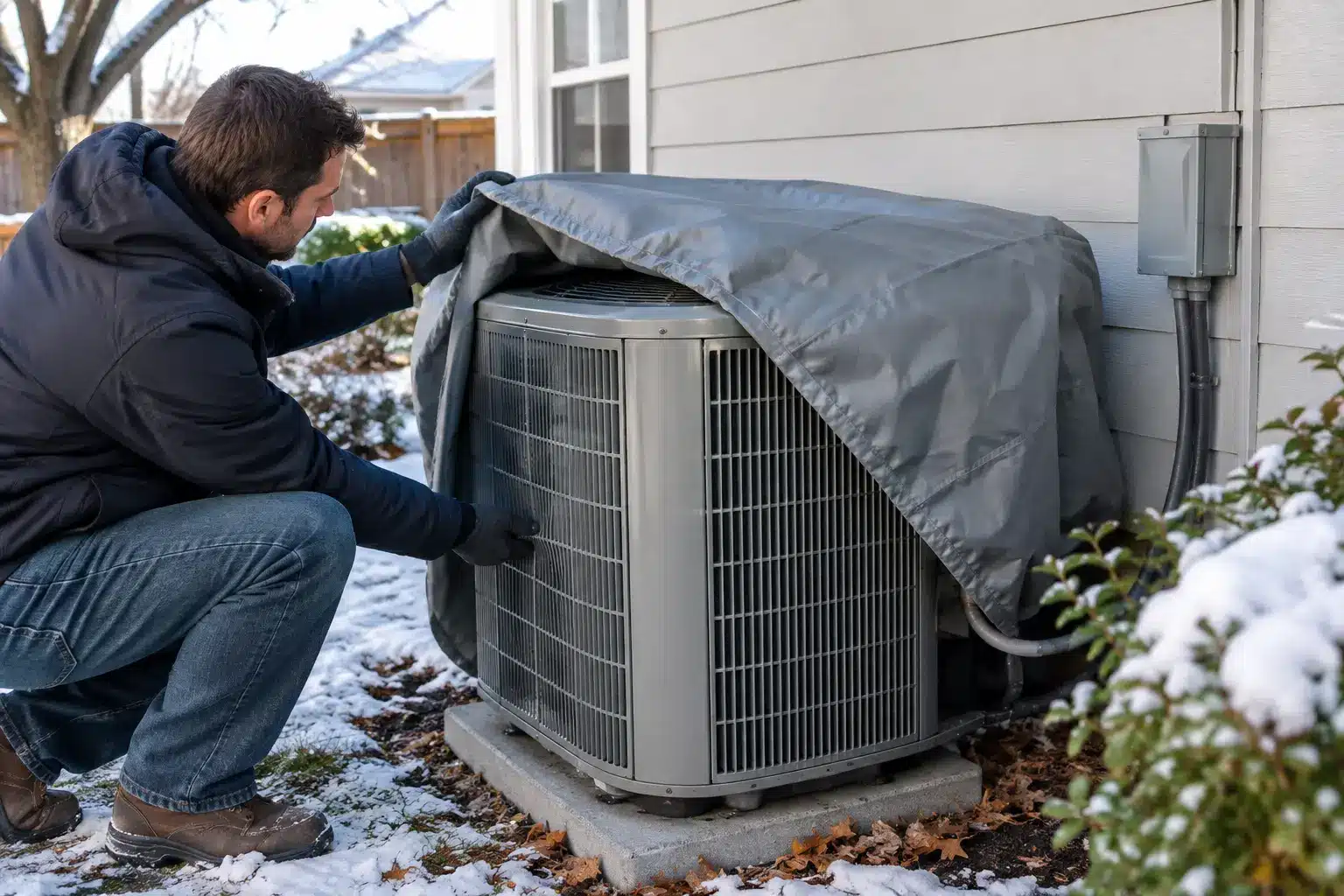
Leave it uncovered. A full wrap-around cover on a Sacramento condenser does more damage over a winter than the rain it was bought to block, and most of the covers sold at hardware stores in October are solving a problem this valley does not have.
That answer surprises people, because covering things up feels like care. The question homeowners type in every October, should you cover your AC unit in the winter, gets a different answer in the Central Valley than it does in Minnesota, and most of the advice online was written for Minnesota. The outdoor unit sitting on the slab beside your house was built to live outside in weather far worse than ours. What it was never built for is being sealed inside a vinyl bag for four months while Sacramento’s winter humidity and tule fog sit against the metal with no way out.
Here is what winter does to that unit, and the small amount of protection worth your time
What is the outside AC unit called, and what is inside it
The box outside is the condenser, and the full name on most manufacturer documentation is the AC condenser unit or condensing unit. Some technicians call it the outdoor unit or the compressor, though the compressor is one part inside it rather than the whole thing. On a heat pump system, that same box is called the outdoor unit and it runs year round.
Four things live in that cabinet, and each one reacts differently to winter.
The condenser coils wrap around the inside perimeter behind the protective grille. They are copper tubing threaded through thin aluminum fins, and they are what dumps your home’s heat into the outside air during summer. The fins bend if you lean a ladder against them, which is why the metal grille exists.
The compressor is the heavy cylinder at the center. It is sealed, filled with refrigerant and oil, and it is the most expensive single part of your air conditioning system.
The refrigerant lines run from the unit through your exterior wall. You will see two copper lines, one thin and bare, one thicker and wrapped in black foam insulation. That foam matters, and it is the part of your system most likely to need attention before winter.
The electrical components sit behind a removable service panel: the contactor, the run capacitor, the wiring to the fan motor and compressor. There is also a disconnect box mounted on the wall within a few feet of the unit. Water intrusion into any of that is a real repair. Water landing on the coils is not.
Why covering the whole unit is the wrong move
A condenser is designed to be rained on. It is a galvanized or powder-coated steel cabinet with drainage at the base, mounted on a pad so water runs out the bottom. Rain on the coils is closer to a free rinse than a threat, and manufacturers do not require covers under warranty. Not Carrier, not Trane, not Lennox, not Goodman.
What a full cover does is change the humidity inside the cabinet. Sacramento does not get dry in winter. We get weeks of fog, saturated morning air, and long stretches where nothing sitting outdoors ever fully dries. Seal a vinyl or plastic cover over a condenser in that climate and you create a pocket where moisture buildup has no exit. Condensation forms on the inside of the cover at night, drips onto the coils, and stays there. The metal spends the entire winter damp instead of drying out between storms.
That is how rust and corrosion start on a condenser. Not from rain. From a cover.
Rodents move into covered units
The second problem is worse and more expensive. A covered outdoor condenser in December is a dark box that stays dry and out of the wind, and rats and mice in this region treat it as an invitation. They nest in the base of the cabinet and chew the wiring insulation, because rodent teeth do not distinguish between a twig and a low-voltage control wire.
Homeowners find out in May. The system gets its first cooling call of the year, nothing happens, and the technician pulls the service panel to find shredded insulation, chewed thermostat wire, and a nest packed against the contactor. Ask any Sacramento HVAC company how many of those calls they run in the first warm week of spring. It is not a rare failure.
Never cover a heat pump
If your system heats the house with the outdoor unit rather than a gas furnace, you have a heat pump, and covering it in winter is a genuine hazard. That unit runs at the coldest hours of the year. Restricting airflow across the coil while the system is operating causes the unit to ice over, forces the compressor into high pressure, and can destroy it in one season.
Check before you buy anything. If your outdoor unit turns on during cold weather, it is a heat pump. Leave it alone.
When an outdoor AC unit cover does make sense
There is one version worth using, and it is a lid rather than a bag. Ask why cover AC unit in winter and the honest answer is falling material, so a cover only needs to handle what falls.
A top-only cover sits on the upper surface of the cabinet and hangs down four to six inches on each side. It keeps falling leaves and debris out of the fan opening and stops water from dropping straight down onto the fan motor, while leaving the sides completely open so air moves and the metal dries. A piece of plywood weighted with a brick does the same job for nothing.
Buy or build the top cover if your condenser sits under a valley oak, a liquidambar, a sycamore, or anything else that drops through November and December. Leaf drop is the single real winter threat to these units, because wet leaves pack into the base and hold water against the pan.
Skip the cover entirely if the unit sits in the open with nothing above it. Nothing about Sacramento winter requires one.
So the practical answer on how to cover AC unit for winter is partial coverage, high up, with airflow preserved on every side.
What to avoid: anything that wraps all four sides, anything made of solid plastic or vinyl, anything marketed as a full ac condenser cover with a drawstring at the bottom. If you already own one, cut the sides off and keep the top.
How to winterize an AC unit in Sacramento
Most advice on how to winterize AC unit hardware assumes snow country, where the concern is ice load and spring thaw. Ours is dust and leaf drop, plus the UV damage left over from the summer that just ended. Real winterizing here takes about thirty minutes in late October or early November, and this is the ac maintenance checklist worth following.
1. Cut back plants and shrubs to at least two feet on every side of the unit and clear anything growing over the top. Vegetation crowding the cabinet is the most common airflow restriction technicians find.
2. Pull leaves and debris out by hand and off the top grille. Check the base of the cabinet, where leaves collect and stay wet all winter.
3. Rinse the condenser coils. Instructions for how to clean outside ac unit coils are simpler than most people expect: shut off power at the disconnect, use a garden hose with normal pressure, and spray from the inside out through the top opening so dirt exits the way it came in. Never use a pressure washer. The fins fold over at surprisingly low pressure, and folded fins block airflow permanently.
4. Inspect the black foam on the larger refrigerant line. Sacramento sun destroys that insulation over five to seven summers. If it is cracked, crumbling, or missing sections, replace it with pipe insulation from any hardware store. Bare refrigerant line costs you efficiency every cooling season and lets the line sweat against the wall.
5. Look at the pad. If the unit has settled and is sitting at an angle, note it. A tilted condenser drains poorly and stresses the refrigerant line connections. It is fixable, and it gets worse if ignored.
6. Change the indoor filter. Your furnace and air conditioner share the same blower and the same filter, and the system is about to run for four months.
That is the whole job. Nothing gets wrapped or sealed. Search results for how to protect AC unit in winter will push covers at you, and the six steps above do more for the equipment than any cover on the shelf.

About shutting off power for the winter
On an air conditioner paired with a gas furnace, you can switch off the 240 volt disconnect beside the condenser for the winter. The reason is narrow. It prevents the compressor from starting if someone bumps the thermostat into COOL on a cold day, and starting a compressor at 40 degrees with cold, thick oil is hard on it.
Two conditions apply. Turn the power back on twenty four hours before you use cooling in spring, because units with a crankcase heater need that time to warm the oil and separate the refrigerant out of it. And never do this on a heat pump, which needs power all winter to heat your house.
If remembering the spring step sounds like a problem, leave the power on. The risk of an accidental winter start is small compared to the risk of a compressor started with cold oil in April.
Ice, freezing, and what to do about it
A standard air conditioner does not run in winter, so it cannot freeze the way people imagine. If you see ice on the outdoor unit after a freezing rain or a hard frost, it came from the sky and it will melt. Ice sitting on an idle condenser causes no harm.
The question of how to keep outside ac unit from freezing in winter matters for heat pumps, where the outdoor coil genuinely does frost over during operation. That is normal. The system runs a defrost cycle every thirty to ninety minutes in cold weather, briefly reverses itself, melts the frost, and resumes heating. You may see steam and hear a change in sound. Nothing is wrong.
Ice becomes a problem when it stays. A heat pump encased in ice that never clears through several cycles has a failed defrost board, a stuck reversing valve, a bad sensor, or low refrigerant charge, and it needs a technician.
If you need to know how to remove ice from outside AC unit in winter weather before a technician gets there, use a garden hose with cool or lukewarm water and let it run over the coil until the ice releases. Do not chip at it. A screwdriver or an ice scraper punctures the thin copper tubing inside those fins, and a punctured coil turns a service call into a coil replacement. Do not use boiling water either, since the temperature shock can crack a coil that is already at 30 degrees.
Also check the gutter above the unit. Ice that keeps reforming on one spot of an outdoor unit usually traces back to a downspout or a roof edge dumping water directly onto it, and fixing the gutter solves the problem for good.
Window AC units are the exception
Everything above applies to a central system. A window unit is a different machine with a different answer.
Pull it out for the winter if you can. Here is how to store window AC unit for winter without damaging it. Run it on fan only for an hour to dry the interior, tip the drain side down over a sink or outside to empty standing water, wipe the housing, and keep it upright in a garage or closet. Storing a window unit on its side lets compressor oil migrate into the refrigerant lines and it may not run correctly in spring.
If the unit is too heavy to remove or the window frame was built around it, insulate it in place. How to insulate a window ac unit for winter comes down to blocking the airflow path: fit a purpose-made indoor cover over the interior face, seal the gap between the unit and the window sash with foam weatherstripping or rope caulk, and put an outdoor cover over the exterior portion. That is the one case where fully covering an air conditioner is correct, because a window unit is a direct hole through your wall and it will bleed heated air all winter otherwise.
How to protect an AC outdoor unit from sunlight
Questions about how to protect AC outdoor unit from sunlight come up less often than winter ones, and the sun does far more damage here than the cold ever will.
A condenser on the west or south side of a Sacramento house takes 105 degree afternoons for three months straight, and heat reduces its efficiency. Every degree hotter the air entering the coil is, the harder the compressor works to reject heat. Shading the unit helps.
Shade it the right way. Plant a shrub or small tree far enough back that it casts afternoon shade without restricting airflow, or install an awning mounted well above the top of the cabinet. Keep three feet of open space on all sides and five feet of clearance above the fan. What does not work is anything that sits close to the unit or blocks the discharge, because starving the fan of airflow costs more than the shade gains. Slatted fencing placed right against a condenser is the most common version of this mistake in local backyards.
Fall HVAC maintenance is what protects the unit
Covers are a distraction. The thing that keeps a condenser alive is service.
Fall HVAC maintenance in this region usually focuses on the furnace, since that is what runs next. A good visit looks at the outdoor unit too: a technician measures refrigerant pressures while the weather still allows it, checks the capacitor for degradation, inspects the contactor for pitting, cleans the coil properly, and verifies the electrical components are tight and dry. An ac inspection in October catches the capacitor that would have failed in July, and capacitors are cheap until they take the compressor with them.
Service it once a year at minimum, and twice if the equipment is over ten years old or the outdoor unit sits in full afternoon sun. Most Sacramento homeowners schedule a heating visit in fall and a cooling visit in spring, which gives the blower, the coil, and the refrigerant charge two looks a year. Manufacturers require annual service records to honor parts warranties, and homeowners discover this at the worst possible moment.
Sacramento air conditioner maintenance has one local wrinkle worth knowing. Valley dust and agricultural particulate load condenser coils faster here than in coastal climates, and a coil that looks fine from the outside can be packed solid two fins deep. That is a measurable efficiency loss that no homeowner can see and no cover prevents.
Get it looked at before the season turns
Clarke & Rush has worked on Sacramento heating and cooling systems since 1963, and we run hvac tune-up visits on both sides of the year for homeowners in Sacramento, Roseville, Folsom, Elk Grove, and Citrus Heights. If your condenser has been through more than ten summers, if the refrigerant line insulation is falling apart, or if you covered it last winter and want it checked before spring, call 916-609-2665 and we will
schedule an ac inspection.
Anyone who searches should you cover AC unit in winter and ends up buying a forty dollar vinyl wrap would get more out of putting that money toward a coil cleaning. The wrap protects the unit from weather it was designed for. The cleaning addresses the dust that is already costing you efficiency.
We will also tell you honestly if the unit needs nothing. Most of them do not.
Frequently asked questions
Use a top-only cover, which handles the one thing trees cause. A lid that covers the fan opening and hangs down a few inches keeps leaves and debris out of the cabinet while leaving all four sides open so air moves and the metal dries. Skip any cover that wraps the sides, because trapped moisture and nesting rodents cause more damage than a season of falling leaves. Clearing the leaves out by hand in late November works just as well if you would rather not buy anything.
No, and covering it usually causes the corrosion people are trying to prevent. Homeowners asking do I need to cover my AC unit in winter are almost always worried about rain, and rain is the part that does no harm. Condensers are built with drainage and weather-resistant coatings because they are meant to sit in rain. Sealing a cover over one during Sacramento’s foggy months keeps the cabinet damp continuously instead of letting it dry between storms, which is the condition rust needs. The parts that genuinely need protection from water, meaning the electrical components, sit behind a gasketed service panel already.
No. The condenser has no connection to your heating system unless you have a heat pump, and in that case covering it stops your heat entirely. On a gas furnace system the outdoor unit sits idle all winter with no refrigerant circulating and no path for heat to escape your house through it. The one exception is a window air conditioner, which is an actual opening through your wall, and sealing or removing that one does reduce winter heat loss.
If it is a standard air conditioner and it is not running, leave it. The ice came from weather and it will melt without harming anything. If it is a heat pump that is running, some frost is normal and the defrost cycle clears it every thirty to ninety minutes. Ice that persists through multiple cycles or builds into a solid block means the defrost system, the reversing valve, or the refrigerant charge needs attention. To clear ice safely, run cool or lukewarm water from a hose over it. Never chip at ice with a tool, since the copper tubing inside those fins punctures easily.
Once a year for equipment under ten years old, twice a year after that or if the unit takes full western sun. Valley dust loads condenser coils faster than it does in milder climates, and a coil that is dirty two fins deep raises head pressure and shortens compressor life without producing any symptom a homeowner would notice. A yearly visit should include a coil cleaning, a capacitor test, a refrigerant pressure check, an electrical inspection, and a look at the refrigerant line insulation. Most manufacturers also require documented annual service to keep the parts warranty valid.
