
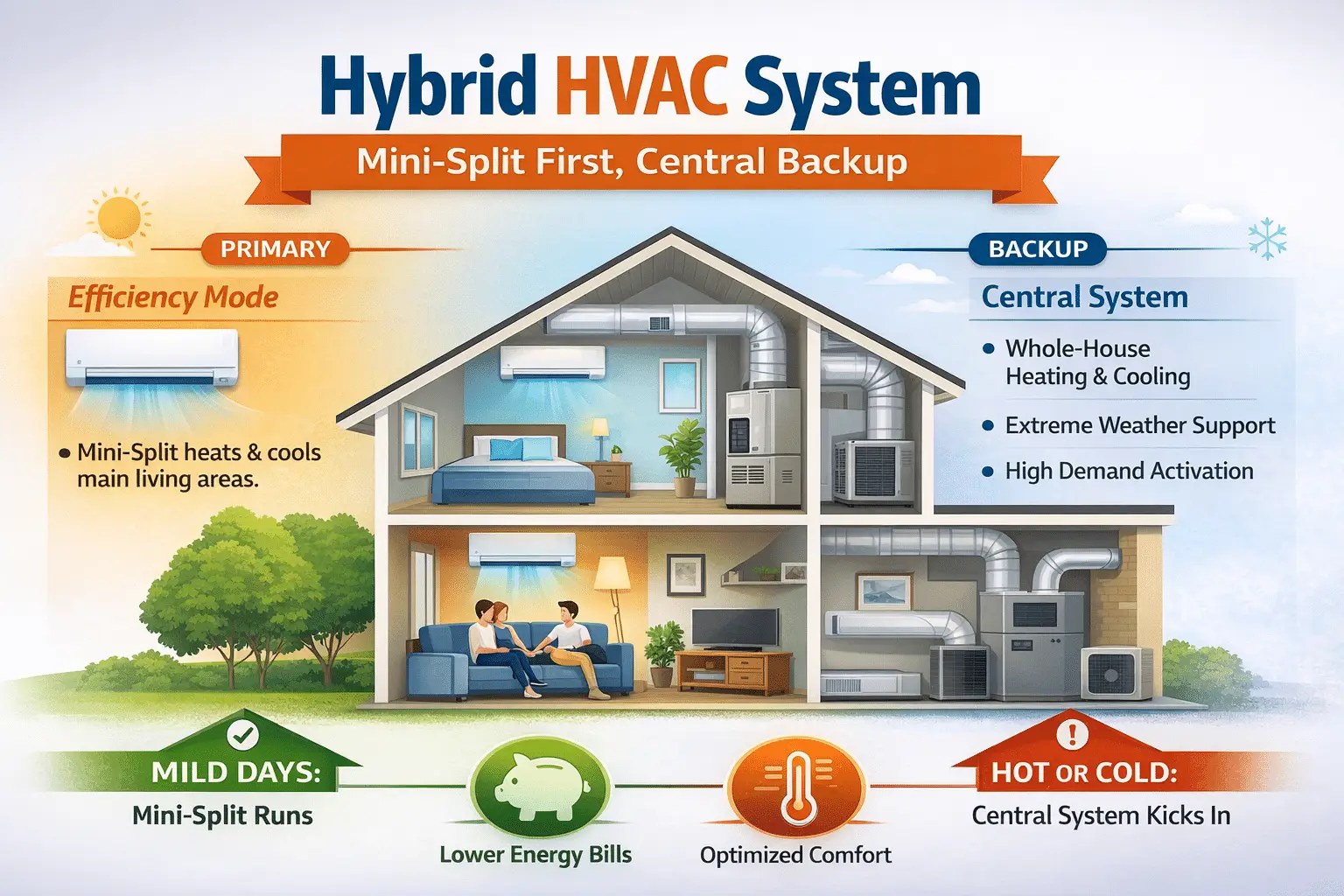
As energy costs continue to rise across California, homeowners are searching for smarter, more efficient ways to stay comfortable year-round. One solution that’s quickly gaining popularity is the hybrid HVAC system—a strategic combination of a ductless mini-split and a traditional central heating and cooling system.
At Clarke & Rush, we’re hearing a common question from Sacramento homeowners:
👉 Can a mini-split run first and only use the central HVAC system when needed?
The answer is yes—and when designed correctly, this approach can significantly improve energy efficiency, comfort, and long-term system performance.
What Is a Hybrid HVAC System?
A hybrid HVAC system combines two technologies into one cohesive solution:
- A ductless mini-split heat pump, which provides highly efficient, zoned heating and cooling
- A central HVAC system, which delivers whole-home comfort when demand is higher
Instead of relying entirely on one system, the mini-split does most of the daily work, while the central system acts as a backup.
According to the U.S. Department of Energy (https://www.energy.gov/eere/buildings/integrated-hvac-control-methods-supplemental-high-efficiency-mini-split-heat-pumps), studies on homes using mini-splits alongside central systems show average energy savings of around 30–35%, making this one of the most efficient HVAC strategies available today.
How the “Mini-Split First” Strategy Works
In a properly designed hybrid system, your home uses energy in a smarter way:
- The mini-split runs first
It handles everyday heating and cooling, especially in occupied areas like living rooms and bedrooms. - The central HVAC system activates only when needed
This happens during:- Extreme heat or cold
- Whole-home temperature adjustments
- Rapid temperature changes
This setup is often referred to as a supplemental mini-split system, and it’s becoming increasingly common in California homes.
Why Hybrid HVAC Systems Are So Energy Efficient
1. Eliminating Duct Energy Loss
Traditional HVAC systems can lose up to 25–30% of energy through ductwork, especially in older homes. Research from https://aboutdarwin.com/mini-split-vs-central-air/ highlights how duct losses significantly impact overall system efficiency.
Mini-splits solve this problem by delivering conditioned air directly into the room—no ducts required.
2. Zoned Comfort = Less Waste
One of the biggest advantages of mini-splits is zoning.
Instead of cooling or heating the entire home, you can focus only on the rooms you’re using. According to https://prospershield.io/blog/ductless-mini-split-systems-complete-guide, this can reduce energy usage by 30–40% compared to traditional systems.
That means:
- No wasted energy on empty rooms
- Personalized comfort for each area
- Lower monthly utility bills
3. High Efficiency in Mild Conditions
Sacramento’s climate is ideal for mini-split performance.
Mini-splits are most efficient during:
- Mild mornings and evenings
- Spring and fall seasons
- Partial occupancy scenarios
Data from the California Energy Commission (https://www.energy.ca.gov/sites/default/files/2024-01/CEC-500-2024-001-APA-G.pdf) shows that high-efficiency heat pump systems, including mini-splits, can deliver up to 40% incremental energy savings compared to standard central air systems.
4. Smarter System Controls
Modern hybrid systems can include smart thermostats and integrated controls that automatically decide:
- Which system should run
- When to switch between systems
- How to minimize energy use
This creates a seamless experience where your HVAC system is always operating at peak efficiency without manual adjustments.
Why Hybrid HVAC Systems Work So Well in Sacramento
Sacramento homeowners are uniquely positioned to benefit from hybrid systems because of the region’s climate and housing characteristics.
Ideal scenarios include:
- Two-story homes with uneven temperatures
- Older homes with inefficient ductwork
- Home additions or converted garages
- Households looking to reduce SMUD energy bills
By using a mini-split for targeted comfort and a central system for backup, homeowners can maintain consistent temperatures while using less energy overall.
Real Cost Savings for Homeowners
Hybrid HVAC systems can lead to significant long-term savings.
For example, https://coolairminisplit.com/mini-splits-2026-real-energy-savings-for-homeowners/ reports that some homeowners see energy bill reductions of up to 38% after installing mini-split systems.
Additionally, research from https://aboutdarwin.com/mini-split-vs-central-air/ suggests annual savings between $1,800 and $3,000, depending on usage and home size.
The biggest savings occur when:
- The mini-split handles most daily operation
- The central system runs less frequently
- The system is properly designed and installed
Hybrid HVAC vs Traditional Systems
Here’s how hybrid systems compare to traditional HVAC setups:
| Feature | Hybrid HVAC System | Traditional HVAC |
|---|---|---|
| Energy Efficiency | High | Moderate |
| Comfort Control | Zoned | Whole-home only |
| Energy Waste | Minimal | Higher (duct loss) |
| Flexibility | Excellent | Limited |
Is a Hybrid HVAC System Right for Your Home?
A hybrid system may be a great fit if you:
✔ Want to reduce energy costs without replacing your entire HVAC system
✔ Have rooms that are consistently too hot or too cold
✔ Are interested in upgrading to energy-efficient heat pump technology
✔ Want a scalable solution for future home improvements
If you’re still exploring your options, Clarke & Rush offers helpful resources like
https://clarke-rush.com/why-are-california-homes-switching-to-heat-pumps/ and
https://clarke-rush.com/understanding-the-factors-that-contribute-to-ductless-ac-costs/ to guide your decision.
Why Professional Design and Installation Matter
Hybrid HVAC systems are highly effective—but only when designed correctly.
At Clarke & Rush, our team ensures:
- Proper system sizing and load calculations
- Strategic mini-split placement for maximum efficiency
- Seamless integration with your existing HVAC system
- Smart control setup for optimal performance
Without proper design, systems can overlap or compete, reducing efficiency instead of improving it.
The Future of Energy-Efficient Home Comfort
As California continues to push toward electrification and energy efficiency, hybrid HVAC systems are becoming a leading solution for homeowners who want:
- Lower energy bills
- Reduced environmental impact
- Improved indoor comfort
- Flexible, future-ready HVAC systems
By combining the efficiency of mini-splits with the power of central HVAC, hybrid systems offer the best of both worlds.
Final Thoughts
So, can a mini-split run before your central HVAC system?
Yes—and it’s one of the smartest upgrades you can make for your home.
By allowing the mini-split to handle everyday comfort and using your central system only when necessary, you can:
✔ Lower your energy bills
✔ Improve comfort in every room
✔ Extend the lifespan of your HVAC system
Ready to Explore a Hybrid HVAC System?
If you’re in the Sacramento area and want to see if a hybrid HVAC system is right for your home, visit https://clarke-rush.com to schedule a consultation with the Clarke & Rush team.