
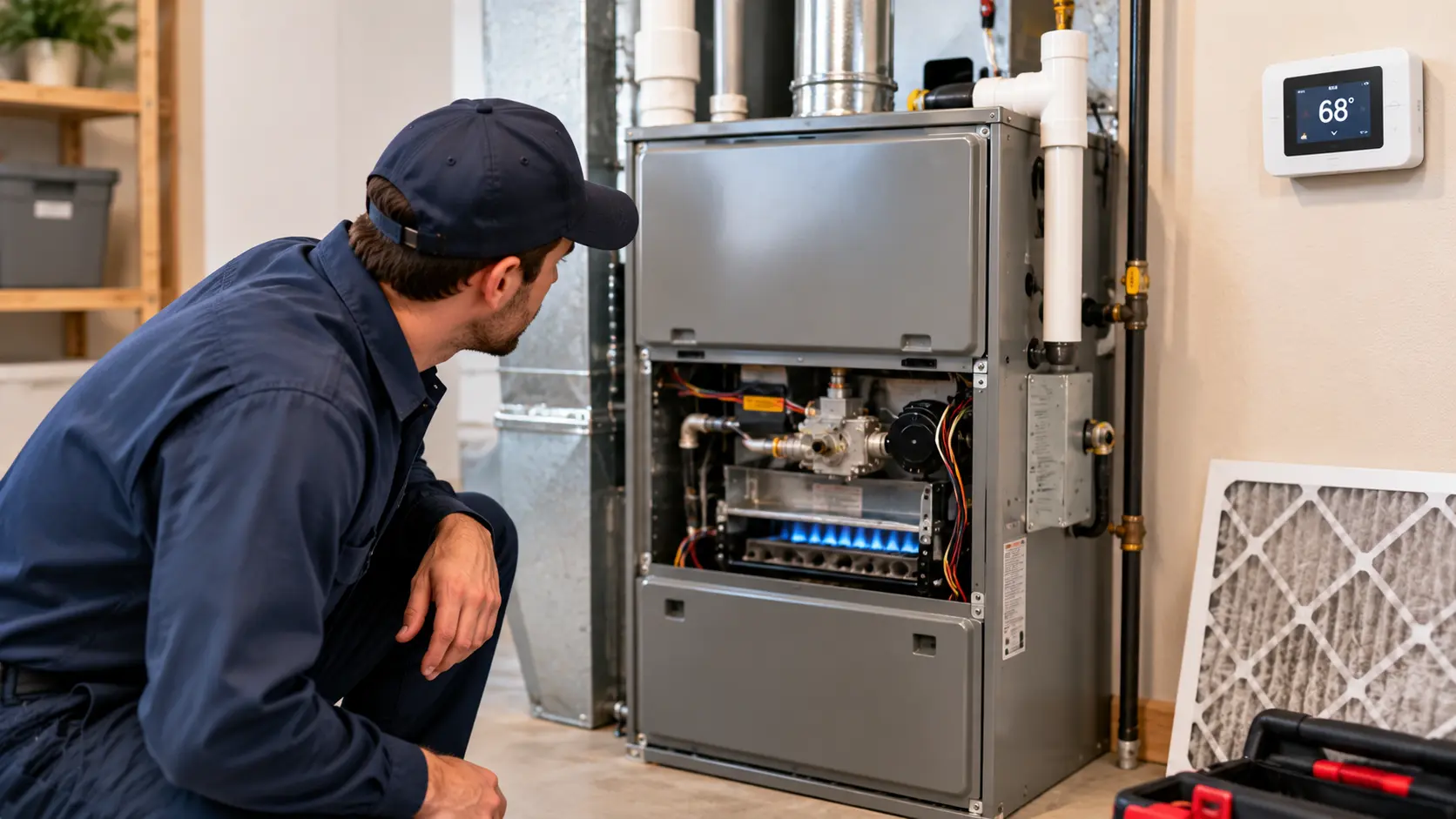
A furnace that used to light within a few seconds and now takes thirty seconds, or a minute, or three tries, is telling you that one step in its startup sequence is struggling. The sequence itself has not changed. Something inside it is dirty, weak, or failing, and the delay is the furnace retrying until it gets what it needs.
Most homeowners wait this one out. It still heats the house, so it goes on the list for later. That is the expensive choice. Delayed ignition means unburned gas sits in the burner compartment before it lights, and when it finally does you get a small rolling flame instead of a clean one. Do that a few hundred times over a winter and you have stressed the heat exchanger, the part that separates combustion gases from the air in your bedrooms.
Here is what causes a slow starting furnace, in the order an hvac technician checks it.
What your furnace is doing during those thirty seconds
Modern furnaces do not just light. They run a sequence, and each step waits for confirmation before the next one begins.
The thermostat calls for heat. The control board wakes up and checks its safety circuits. The draft inducer motor starts and pulls air through the heat exchanger, and a pressure switch has to close to prove that air is actually moving. Only then does the igniter energize. On a hot surface ignition system that igniter needs about 20 to 45 seconds to reach roughly 1,800 degrees. The gas valve opens, the burners light, a flame sensor confirms the flame within a few seconds, and about 30 to 60 seconds later the blower starts moving warm air into the house.
Add it up and a normal furnace takes somewhere between 60 and 90 seconds from thermostat call to warm air at the vent. That is not a problem. What matters is change. If yours used to do it in a minute and now takes four, or if you hear it try and fail and try again, the furnace is failing a step and running its retry routine.
Most control boards allow three or four ignition attempts before locking out for an hour. A furnace that heats fine in the evening and is stone cold at 5am is often a furnace that went into lockout overnight.
Six reasons your furnace takes a long time to turn on
1. A dirty or weak flame sensor
This is the most common cause of furnace ignition problems, and the cheapest fix on the list.
The flame sensor is a thin metal rod that sits in the burner flame. It works by passing a tiny electrical current, measured in microamps, through the flame itself. The control board reads that current as proof the burners lit. A healthy sensor reads somewhere around 4 to 6 microamps on most equipment, and manufacturers usually want at least 1.5 to stay in operation.
Over a season the rod develops a film of silica and carbon. The current drops. The board stops seeing a flame it can trust, shuts the gas valve within about two seconds, and starts the whole sequence over. From the hallway that sounds like the furnace lighting, running for a second or two, going quiet, then trying again a minute later. It might catch on the third try.
Cleaning a flame sensor takes a technician a few minutes with fine abrasive cloth. Ignoring it means lockouts on the coldest nights, because a marginal sensor fails first when the furnace is cycling hardest.
2. An aging hot surface igniter
Silicon carbide and silicon nitride igniters both degrade with every cycle. They get more electrically resistant as they age, which means they heat more slowly and reach a lower peak temperature. The gas valve still opens on the board’s schedule, so gas arrives at a burner the igniter is not quite hot enough to light cleanly.
That is furnace delayed ignition. The gas pools for a moment, then lights all at once with a soft whump or a bang. If you hear that sound at startup, stop reading and book service.
Igniters usually last 3 to 7 years in a Sacramento home. They fail more often on systems that short cycle, because every extra cycle is another thermal shock to a brittle ceramic part. A cracked igniter often still glows, which is why people replace other parts first and stay puzzled. A resistance test settles it in under a minute.
Older furnaces with a standing pilot fail differently. A pilot that burns lazy and yellow, or one that keeps going out, usually means a partly blocked pilot orifice or a weak thermocouple.
3. A clogged furnace filter starving the system
A dirty furnace filter causes a slow start in a way that surprises people, because the filter is nowhere near the igniter.
Restricted airflow makes heat build up inside the cabinet. The high limit switch trips to protect the heat exchanger and cuts the burners. The blower keeps running to dump that heat, and the furnace will not attempt another ignition until the limit resets. So the system takes several minutes to restart, and once it does it repeats the pattern. That is furnace short cycling, and it is the single most common reason a furnace starts and stops all evening.
Check it yourself. Pull the filter and hold it to a light. If the pleats are grey and you cannot see light through them, replace it. A one inch pleated filter in a Sacramento house needs changing every 60 to 90 days, and closer to 30 with pets or during wildfire smoke season. Four and five inch media filters last six months to a year.
One detail people get backwards: the arrow on the filter frame points toward the furnace, in the direction air travels. Installed backwards, the filter collapses into itself and chokes the system on day one.
4. A failing pressure switch or a blocked flue
The pressure switch is the safety device that proves your draft inducer is moving combustion air. Until it closes, the board will not energize the igniter, no matter how good that igniter is.
When a furnace sits for twenty or thirty seconds after the inducer starts and then goes quiet, this circuit is usually the reason. Sometimes the switch itself is worn and slow to make contact. More often the problem is upstream of it. The small rubber hose that connects the switch to the inducer housing cracks or fills with condensate. The condensate drain on a high efficiency furnace clogs with scale and backs water into the trap. The PVC flue terminating outside gets blocked by a bird nest, a wasp nest, or landscaping that grew over it during summer.
This one is a safety circuit doing exactly what it should. The furnace refusing to light because it cannot prove venting is the system protecting you from carbon monoxide. The fix is finding the restriction, not bypassing the switch, and any technician who jumps a pressure switch to get you through the night should not be in your house.
5. Gas supply and gas valve problems
A furnace needs correct gas pressure to light quickly. Manifold pressure on a natural gas furnace typically runs around 3.5 inches of water column on the high stage, and the incoming supply usually sits near 7 inches. Low pressure means a lazy flame that the sensor struggles to read, so you get the same retry behavior as a dirty sensor.
Causes vary. A partly closed manual shutoff valve after someone worked on the line. An undersized gas line feeding a furnace plus a pool heater plus a tankless water heater, where everything runs fine alone and the furnace starves when the water heater fires. A gas valve solenoid that has weakened with age and opens slowly.
Two stage furnaces add their own wrinkle. They start on low fire by design, which is quieter and slower to produce noticeable heat, and homeowners who just had one installed sometimes report a slow start when the furnace is behaving normally.
6. Thermostat and control board faults
Check the thermostat before assuming the worst, because it starts the entire sequence.
Weak batteries in a battery powered thermostat cause intermittent calls for heat that look exactly like a furnace problem. Loose or corroded wire at the terminals does the same. A thermostat mounted in direct sun, above a lamp, or on an exterior wall reads a temperature that has little to do with the rest of the house and calls for heat at the wrong times.
Smart thermostats introduce a setting worth knowing about. Many run adaptive or early start logic, which fires the furnace ahead of your scheduled time so the house reaches temperature at the scheduled moment rather than starting then. Some also apply a compressor or cycle delay of up to five minutes. Neither is a fault, and both look like a slow furnace until you find the setting.
Control boards fail too, usually with cracked solder joints or a weak relay, and the symptom is inconsistency. The furnace works perfectly for a week, then takes four attempts on a Thursday. Boards are also where a failed diagnosis gets expensive, which is why a proper furnace diagnosis tests the cheap parts first.

How to check it yourself in ten minutes
Run through this before you call anyone.
1. Watch and count. Time from thermostat call to burner ignition, and note whether the inducer, the igniter glow, and the burners each happen.
2. Listen for repeat attempts. Two or more tries per heating call points at the flame sensor or the igniter.
3. Pull the filter and hold it to a light. Replace it if loaded.
4. Walk the house and open every supply register. Clear anything within two feet of the return grille.
5. Check the thermostat batteries and look for an early start or adaptive recovery setting.
6. Go outside and look at the flue termination on the wall or roof. Clear nests, leaves, or snow.
7. Note any boom, bang, or whump at ignition. Stop using the furnace and call if you hear one.
If a new filter fixes it, you are finished. If the furnace still hesitates, the problem is inside the equipment and needs meters.
Why Sacramento furnaces do this every November
Our heating season is short and hard on equipment. A furnace here sits unused from April to late October while the air conditioner pulls Valley dust, agricultural particulate, and wildfire smoke residue through the same cabinet and the same blower. Everything summer collected is still on the flame sensor, on the burners, and in the filter when you ask for heat on the first cold morning.
Attic installation makes it worse. A large share of houses built here since the 1970s put the furnace and the entire duct system in an unconditioned attic, where temperature swings loosen connections, condensate lines sag, and anyone working on solar, cable, or insulation can crush a flex duct without noticing.
Scheduling furnace maintenance in Sacramento before the heating season catches nearly all of this. A real heating maintenance visit includes cleaning the flame sensor, testing igniter resistance, reading microamp signal, checking manifold pressure, measuring temperature rise and static pressure, and inspecting the heat exchanger. Those numbers show a problem months before you feel one at the vent.
When to call for furnace repair in Sacramento
Call if the furnace takes more than three attempts to light, if it locks out and needs a power cycle to run, if you hear a boom at ignition, if it runs for less than five minutes before shutting off, or if the carbon monoxide alarm sounds at any point. Leave the house and call the gas utility first for that last one.
A good furnace inspection measures rather than guesses. Microamp reading on the flame sensor, resistance on the igniter, static pressure on both sides of the air handler, manifold pressure at the valve, and temperature rise across the heat exchanger. A quote written without those numbers is a guess, and guessing on heating system repair is how a $180 flame sensor cleaning turns into a control board nobody needed.
Clarke & Rush has handled heating repair in Sacramento since 1963, and we cover furnace repair in Sacramento CA along with Roseville, Folsom, Elk Grove, Citrus Heights, Carmichael, and Rancho Cordova. Call 916-609-2665 to book furnace service in Sacramento, schedule seasonal heating service, or set up a maintenance plan before the first cold week.
Frequently asked questions
From the thermostat call to burners lighting, expect 30 to 60 seconds on a hot surface ignition furnace, and another 30 to 60 seconds before the blower sends warm air to the vents. So roughly one to two minutes total is normal. The number matters less than the change. A furnace that always took 90 seconds and still does is fine. One that used to take 45 seconds and now takes four minutes has a problem worth diagnosing, even though it still heats the house.
It depends on why. A slow start caused by a dirty filter or a smart thermostat setting is not a safety issue, though the filter version does shorten the life of the equipment. Delayed ignition is different. If gas accumulates before lighting, you get a small explosion inside the burner compartment every cycle, and that cracks heat exchangers and can push combustion gases into your air supply. Any boom, bang, or rumble at startup means shut the furnace off at the thermostat and book service the same day.
That pattern almost always points at the flame sensor. The burners light, the board looks for flame current, does not find enough, and closes the gas valve within about two seconds as a safety response. After a purge cycle it tries again, usually three or four times, then locks out for an hour. Cleaning the sensor fixes most of these. If a cleaned sensor still reads low microamps, the next suspects are burner alignment, a grounding problem, or a control board that can no longer read the signal.
Yes, through the high limit switch. Restricted airflow lets heat build inside the cabinet, the limit trips, and the burners shut off while the blower keeps running. The furnace will not attempt ignition again until that limit cools and resets, which takes several minutes. Homeowners read the wait as a slow start. A clogged furnace filter is the cheapest thing on this list to rule out, which is why any honest heating company tells you to check it before booking a visit.
The range is wide because the causes are. Cleaning a flame sensor during a maintenance visit is often included in the visit price. A hot surface igniter is a modest parts and labor job on most residential equipment. A pressure switch or a gas valve costs more, and a control board more again. Ask for the measured readings behind any recommendation before you approve work. If a company cannot tell you the microamp reading, the igniter resistance, or the static pressure, they have not diagnosed the furnace.
