
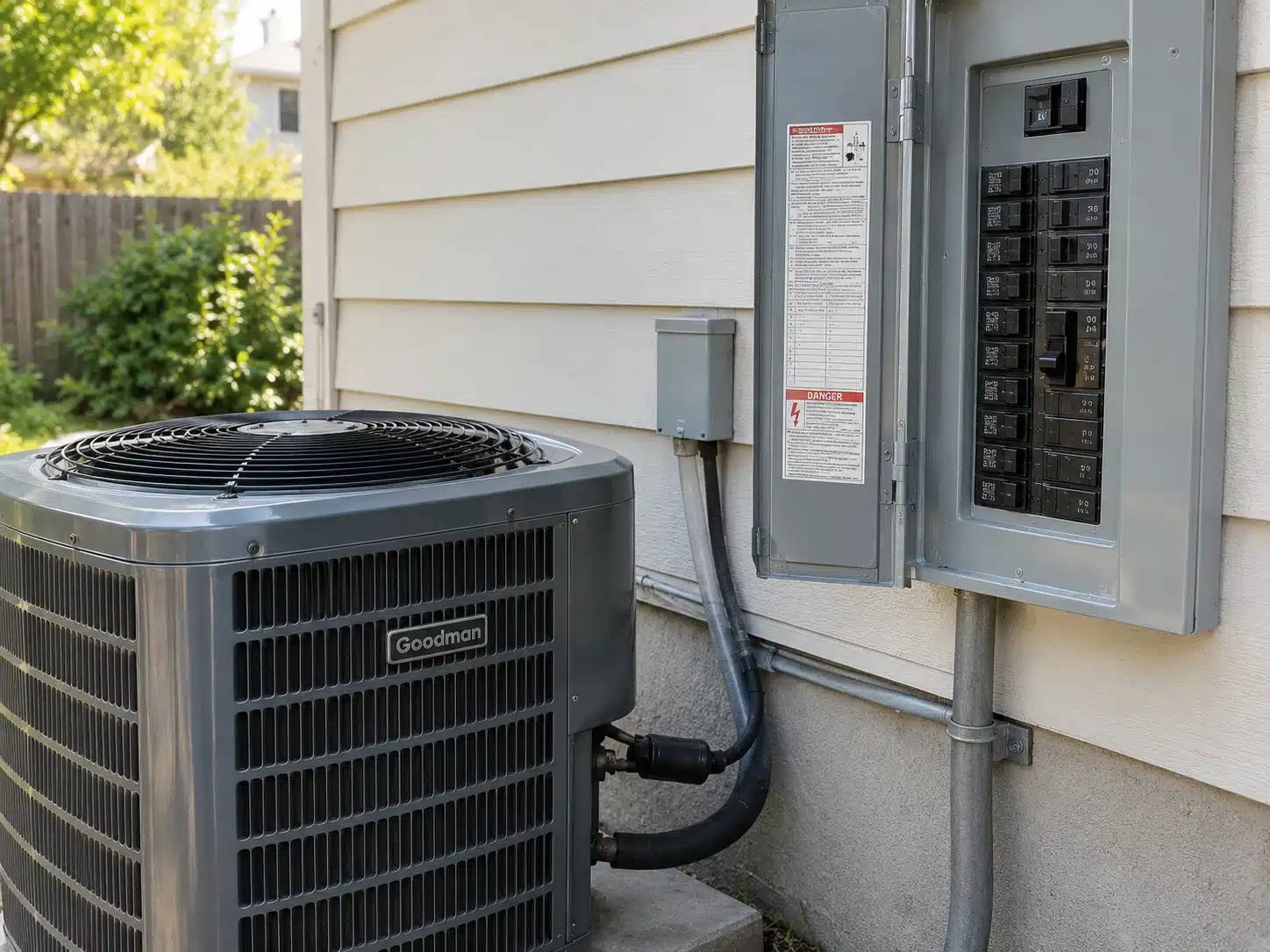
Your breaker is doing its job. That’s the part most homeowners get backward. A breaker trips because it measured more current than the wire behind it can safely carry, and your air conditioner is pulling that current for a reason. Something in the system is working harder than it was built to, or electricity is finding a path it shouldn’t have.
The useful question is what the breaker found.
An AC circuit breaker keeps tripping for a short list of reasons, and a technician can work through all of them in a single visit. The answer ranges from a filter you can replace in two minutes to a compressor that needs to come out. Below is how the causes sort out and what you can safely check before calling anyone. There’s also a point where continuing to reset the breaker starts costing you real money, and it comes sooner than most people think.
What a tripping breaker is telling you
A standard breaker opens under two conditions.
The first is an electrical overload. The circuit draws more amperage than its rating for long enough to heat a bimetallic strip inside the breaker, the strip bends, and the contacts separate. This one builds slowly. Your AC might run for five minutes, or twenty, before it trips.
The second is an electrical short circuit. Current jumps its intended path, resistance drops to almost nothing, and amperage spikes in milliseconds. A magnetic element inside the breaker slams open. This one is instant and usually violent enough that you hear it.
There’s also the ground fault, where current escapes to the equipment chassis or the earth instead of returning on the neutral. Grounded compressor windings are the classic version, and they behave like a short.
Timing is your first diagnostic tool. Write down what happens.
If the breaker trips when the AC turns on, in the same second the compressor tries to start, you’re looking at a short or a ground fault. If the AC runs for a while and then trips, you’re looking at heat and amperage climbing past the limit. Those two patterns point at different parts of the system, so the detail is worth reporting when you call.
Circuit breaker tripping is a symptom with an electrical cause, and it doesn’t clear itself. A breaker that opened once on a freak surge and never repeats is one thing. A breaker that opens every afternoon at 3 p.m. has found a fault.
The most common reasons an AC breaker keeps tripping
A clogged air filter
Start here because it’s free to check and it causes more problems than its price suggests. A dirty filter chokes airflow across the evaporator coil. With too little warm air moving over it, the coil drops below freezing and builds ice. The blower motor strains against the restriction and pulls more amps. Refrigerant that should have boiled off in the coil comes back to the compressor as liquid.
None of that is good for the equipment, and on a marginal circuit it’s enough to push the breaker over. If your AC keeps tripping the breaker and you can’t remember the last filter change, change it before you do anything else. It costs a few dollars and rules out one variable.
A dirty condenser coil
The outdoor unit’s only job is dumping heat outside. When the coil fins pack with dust, cottonwood, grass clippings, and dryer lint, that heat has nowhere to go. Head pressure inside the system climbs. The compressor has to push against that pressure, and pushing harder means drawing more current.
In Sacramento this is the reason I’d bet on first during a July heat wave. A dirty condenser coil that was tolerable in May becomes a breaker-tripper at 105 degrees, because the unit already has less temperature difference to work with.
A failing AC capacitor
The capacitor is a cylinder inside the outdoor unit that stores a charge and releases it to get the compressor and fan motors spinning. Motors draw enormous current at the moment of startup, often several times their running amperage. The capacitor covers that surge.
When a capacitor weakens, the motor tries to start without enough help. It sits there drawing locked rotor amperage, which can run five to eight times normal, until either the internal overload opens or the breaker does. A humming outdoor unit that won’t spin is the signature. Capacitors fail faster in heat, which is why so many die in August rather than April.
Testing one takes a technician about ninety seconds with a meter. Replacing one is inexpensive. Ignoring one can cook a compressor.
A bad condenser fan motor
The fan on top of the outdoor unit pulls air across the coil. When its bearings wear, the motor drags, and a dragging motor pulls more amps. Sometimes the motor seizes outright and shorts.
There’s a second-order problem here that matters more than the first. When the condenser fan quits, the coil stops rejecting heat, head pressure spikes, and the compressor overheats. Now you have two failures instead of one. A fan motor that’s getting noisy or running hot is worth replacing before it takes the compressor with it.
The AC compressor itself
This is the expensive one, and it fails in a few different ways.
Mechanical failure comes first. Internal bearings or the scroll seize, the motor can’t turn, and you get locked rotor current every time it tries to start. The breaker trips within seconds.
Grounded windings are the other instant trip. Insulation inside the motor breaks down and current leaks to the compressor housing. A technician confirms it with a megohmmeter reading between the terminals and ground, and the number is not ambiguous.
Then there’s overheating, where the compressor runs but its internal temperature climbs past the limit. AC compressor overheating usually traces back to something else on this list, like low refrigerant or a dead fan motor.
A compressor that trips the breaker instantly and reads a dead short to ground is done. There is no repair for that.
An overloaded circuit
Sometimes the AC isn’t the problem. Sometimes the circuit was already carrying too much and the AC startup surge is what breaks the tie.
This shows up in older Sacramento homes where a 100 amp panel is running a modern load it was never sized for. It also shows up after a remodel, when someone tapped the nearest available circuit for a new outlet, a garage freezer, or a pool pump. If the breaker also trips when the microwave and the AC run together, you have an overloaded circuit and not an AC failure.
Faulty wiring and a bad AC disconnect
The AC disconnect is the small box mounted on the wall near the outdoor unit. Inside it are lugs, a pull-out block or fused switch, and connections that live outdoors in weather for twenty years.
Corrosion builds on those lugs and connections loosen from thermal cycling. Rodents chew insulation in the whip between the disconnect and the unit. Either one produces a short or an arc that trips the breaker. Faulty wiring inside the condenser cabinet does the same thing, especially where wires pass through sharp sheet metal and the insulation rubs away over years of vibration.
Burn marks, melted insulation, or a scorched smell at the disconnect mean stop. That’s a call, not a project.
Low refrigerant or an overcharge
Both extremes raise compressor current. Low charge means the compressor runs longer and hotter with less refrigerant returning to cool the motor windings. An overcharge raises head pressure directly. Either way the amp draw climbs toward the breaker’s limit.
Low refrigerant also means a leak, since these systems don’t consume it. Adding refrigerant without finding the leak is money spent on a slow drip.
A worn out breaker
Breakers are mechanical devices and they age. One that has tripped repeatedly, or that sits in a hot panel, or that has spent thirty years in a garage in Sacramento summers, can start tripping below its rated amperage. Loose bus connections in the panel produce heat that accelerates it.
A technician confirms this by measuring actual running amperage against the breaker’s rating. If the unit is drawing 22 amps on a 30 amp breaker and the breaker keeps opening, the breaker is the fault.

When the AC won’t stay on but the breaker holds
Sometimes the breaker stays closed and the unit still quits on its own after a few minutes. That’s a different fault path with overlapping causes, so it’s worth separating.
Compressors and motors have internal thermal overloads that open before the breaker does. When an AC won’t stay on and the breaker is fine, one of those overloads is doing the tripping. The unit shuts down, cools off for ten or fifteen minutes, and starts again. Same underlying problem as a breaker trip (high amperage from a dirty coil or a weak capacitor), caught by a different device.
Low voltage at the disconnect does this too, and so does a pitted contactor that can’t hold a solid connection under load. Both are measurable in a few minutes with the right meter.
What you can safely check yourself
There are a few things worth trying before you call anyone. Keep them simple and keep the power off where the instructions say to.
1. Turn the thermostat to off and leave it there for the checks below.
2. Pull the air filter. If light doesn’t pass through it, replace it.
3. Look at the indoor coil and the refrigerant line for ice. If you see ice, leave the system off with the fan running to thaw it, which can take a few hours.
4. Shut off power at the disconnect and the breaker, then look at the outdoor unit. Clear weeds and debris from around it and give the coil fins a gentle rinse with a garden hose from the inside out. No pressure washer.
5. Check what else shares the circuit. Unplug anything you added recently.
6. Reset the breaker once. All the way off, pause, then firmly on.
If it trips again after that reset, stop and call an HVAC technician near you.
Stop resetting the breaker
Every reset sends full startup current into whatever is wrong. If a compressor winding is grounded, you’re arcing inside the motor. If a wire is shorted at the disconnect, you’re arcing inside a metal box outdoors. Each cycle degrades insulation further, damages parts that were fine, and raises the risk of an electrical fire.
Two resets is the limit. After that you’re gambling with a panel.
And never install a larger breaker to make the problem stop. The breaker is sized to the wire, and a 30 amp breaker on 10 gauge wire is not an arbitrary pairing. Put a 40 amp breaker there and the wire inside your wall becomes the weakest link. It will heat up long before the breaker opens. That mistake starts house fires, and it’s the single worst thing a homeowner can do about a breaker that keeps tripping.
When this becomes an emergency
Call for emergency AC Repair right away if you smell burning plastic or hot metal, see scorch marks at the panel or the disconnect, find the breaker hot to the touch, hear buzzing or crackling from the panel, or watch the breaker trip the instant you reset it. Any of those means active arcing or a short that hasn’t finished failing yet.
Heat is its own emergency. When Sacramento sits above 100 degrees for a stretch and the house has infants or elderly residents, a dead AC stops being a comfort problem. Say that when you call so the dispatcher can prioritize you.
How a technician actually diagnoses it
Professional AC repair on a breaker complaint follows a sequence, and it doesn’t start with parts.
The tech clamps a meter around the line conductors and reads actual amperage during startup and steady running, then compares those numbers to the RLA and LRA stamped on the unit’s nameplate. That single measurement separates an overload from a short and tells them whether the unit or the breaker is out of spec.
From there they test the capacitor’s actual microfarad value against its rating, check the contactor for pitted or welded contacts, megger the compressor windings to look for a ground, verify voltage at the disconnect under load, and inspect wiring for damage. Refrigerant pressures and temperature split come next if the electrical side reads clean.
One pattern worth mentioning to the tech: if your HVAC breaker keeps tripping in winter as well as summer, the fault is probably in something both modes share, like the disconnect or the wiring between it and the panel. A summer-only trip points at the condenser.
You should get an answer backed by a measurement. If a company wants to replace a compressor without showing you a resistance reading to ground, get a second opinion.
Keeping it from happening again
Filters every 30 to 90 days, and closer to 30 if you have pets or live near open fields. An annual tune-up scheduled before May, when a Sacramento HVAC company still has open slots and your capacitor can be tested before the first heat wave leans on it. Two feet of clearance around the condenser, with shrubs cut back and nothing stored against the cabinet. A rinse of the outdoor coil twice during summer.
Capacitors are the cheap insurance in this list. When a tech tells you yours is reading 32 microfarads against a 45 rating, replace it that day.
Getting help in Sacramento
Clarke & Rush handles HVAC repair in Sacramento along with the electrical side of these problems, and that combination matters here more than it looks. A breaker that keeps tripping when the AC turns on can be a fault in the equipment or a fault in the panel and wiring feeding it. Diagnosing both under one roof saves you the coordination between two contractors who each say it belongs to the other.
If your AC trips the breaker when turned on, or your air conditioner won’t turn on at all, call. For a unit that failed on a triple digit afternoon, ask for emergency service when you call.
Frequently asked questions
Because amperage rises with load. On a 105 degree afternoon, the condenser has less temperature difference available to shed heat, so head pressure and compressor current both climb. A unit drawing 24 amps at 85 degrees might draw 29 on a 30 amp breaker at 105. Anything marginal, like a weak capacitor or a dirty coil, becomes a trip on the hottest day of the year. That’s also why so many people discover the problem in August.
Yes, though usually by way of a second failure. The restricted airflow freezes the evaporator coil, liquid refrigerant returns to the compressor, and the compressor draws more current under that load. The blower motor also works harder against the restriction. On a circuit with no headroom left, that added draw is enough. Replacing a filter costs a few dollars and rules out one of the more common causes in about a minute.
It depends entirely on what’s failing, and the range is wide. A capacitor or contactor replacement sits at the low end. A condenser fan motor is in the middle. A compressor replacement or a panel upgrade sits at the high end, sometimes high enough that replacing the whole condensing unit makes more sense on an older system. Ask for a diagnostic first and get the reading that justifies the recommended part.
No. Reset it once. If it trips again, leave it off. Each reset pushes locked rotor current through whatever is faulted, which can turn a repairable capacitor problem into a burned compressor or start a fire inside a wall. Leaving the breaker off costs you cooling for a few hours. Resetting it repeatedly can cost you the system.
Start with HVAC. Most breaker trips on an AC circuit trace back to the equipment rather than the house wiring, and an HVAC technician can measure the unit’s amp draw against its nameplate rating in the first ten minutes. If the readings come back within spec, the problem is on the electrical side, and that’s when a panel or wiring inspection makes sense. A company that does both, like Clarke & Rush, handles that handoff internally instead of sending you looking for a second contractor.