
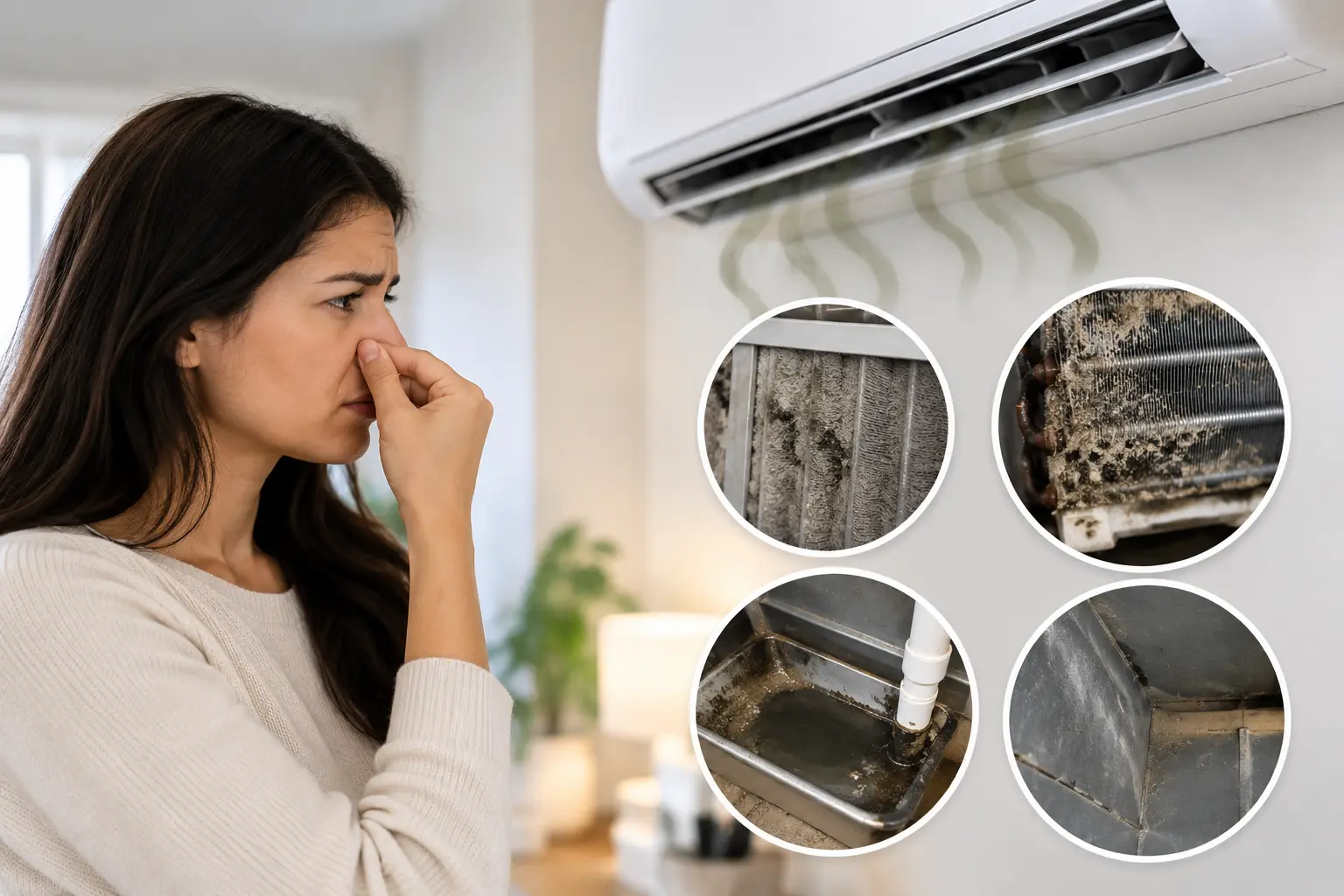
A musty smell from your vents almost always means there is standing moisture somewhere in your system, and something biological is growing in it. Usually mold or mildew. The smell shows up the moment the blower kicks on because air is moving across whatever is wet and pushing that odor into every room on the circuit.
Sacramento makes this worse than it has to be. We run air conditioning hard from May through October, which means the evaporator coil inside your air handler is cold and wet for months. Then the valley gets a humid stretch in late summer, the drain line slows down, and the pan holds water it was supposed to shed. That is the recipe. If your air conditioner smells musty when turned on, the system is telling you where to look.
Here is what causes it, how to tell the harmless version from the one that needs an HVAC technician this week, and what to do about it.
What the musty smell actually is
Your air conditioner does two jobs at once. It cools air and it pulls water out of it. Warm indoor air passes over the evaporator coil, moisture condenses on the cold fins, and the water drips into a pan below. From there it runs out through a condensate drain line.
That is a lot of water. A single AC system in a Sacramento summer can pull several gallons a day out of the air in your house. Everything in that path stays damp: the coil, the pan, the first few feet of the drain, sometimes the insulation around the plenum. Mold does not need much to get going. Dark, wet, and 70 degrees is plenty.
So the musty odor from your air conditioner is not a mystery smell. It is the smell of growth on wet metal and wet insulation, carried by 1,200 cubic feet of air per minute.
Why it is strongest in the first few minutes
Most homeowners describe the same pattern. The HVAC smells musty for the first two or three minutes after startup, then fades. That is because odor builds up in the stagnant air inside the cabinet and ductwork while the system is off. When the blower starts, it clears that pocket all at once. The smell does not disappear after those three minutes. It just drops below the level your nose registers.
The seven most common causes
A dirty evaporator coil
This is the first place we look, and it is the cause most of the time. Dust gets past a cheap or overloaded filter, lands on wet coil fins, and turns into a paste. Now you have organic material plus constant moisture in a spot that never sees light. Coil cleaning solves it, but it has to be done properly. A spray can from the hardware store rinses the front face of the coil and leaves the inside layers untouched, which is where the problem usually sits.
A clogged or sloped condensate drain line
The drain line carries condensate away by gravity. Slime builds up inside it over a season or two, water backs up, and the pan sits full. A full pan is a small indoor pond directly in your airstream. In older Sacramento homes with attic air handlers we also find drain lines that have sagged between supports, which creates a low spot that holds water permanently.
If you are seeing a musty smell from HVAC vents along with water stains on a ceiling below the attic, stop and call for ac repair. That combination means the pan has already overflowed.
A rusted or cracked drain pan
Pans fail. Metal pans rust through at the seams, plastic pans crack with age and heat cycling. Water then sits in insulation or on the platform under the unit instead of draining. That material holds moisture far longer than metal does and it smells much worse.
Wet duct insulation and duct leaks
Flex duct in a 140 degree Sacramento attic will condense moisture on its exterior if the insulation jacket is torn or the inner liner has pulled loose. Insulation soaks it up and stays damp. A duct inspection catches this quickly because the damage is usually visible once you are up there with a light.
Return side leaks cause their own version of the problem. A return duct with a gap in a crawlspace pulls damp crawlspace air straight into your system, bypassing the filter. You get the crawlspace smell delivered to your living room.
An oversized system that short cycles
An AC unit too large for the house cools the thermostat’s location fast, shuts off, and never runs long enough to dehumidify. Short runtimes leave the coil wet and the house humid. Homeowners often read this as a smell problem when it started as a sizing problem. We see it in Sacramento homes where a 5 ton unit was dropped into a house that needed 3.5 tons.
A filter left in too long
A loaded filter restricts airflow, which drops coil temperature and increases condensation. The filter itself also holds dust and moisture and starts to smell. One clean filter will not fix an established mold problem, but a dirty one will keep feeding it.
Something dead or something growing elsewhere
Not every musty smell is mold. Rodents nest in ductwork and attics, and decomposition smells musty before it smells like anything else. Dry P traps in a nearby bathroom can let sewer gas into the return air. A professional hvac inspection separates these, because the fix for each one is completely different.

When a musty smell means call someone
Some of this you can handle yourself. Change the filter. Check that the condensate line is dripping outside while the AC runs. Look at the pan with a flashlight if your air handler is accessible.
Call for air conditioner repair in Sacramento when any of the following is true.
The smell has not improved after a new filter and a week of running. Water is visible in the pan or on the floor near the unit. You see ceiling stains below an attic unit. The odor is strong enough to notice in every room. Anyone in the house has worsening allergy or asthma symptoms that track with the AC running. The system is also cooling poorly or running longer than it used to.
That last one matters more than people expect. A coil coated in biofilm transfers heat badly, so the same mold that smells is also raising your power bill.
What a proper diagnosis looks like
A technician who shows up, sprays something in the return, and leaves has not fixed anything. Here is the sequence that finds the source.
The coil gets inspected directly, with the access panel off and a light on it. The drain pan gets checked for standing water, rust, and slope. The condensate line gets cleared and flow verified at the exit point. Static pressure and temperature split get measured, because both tell you whether airflow is part of the problem. The blower wheel gets looked at, since buildup on the blades holds moisture too. Then the duct runs get checked for torn insulation, disconnected boots, and return leaks.
At Clarke & Rush we have been doing this in the Sacramento area since 1963, and the pattern holds: the odor source is at the coil or the pan roughly three times out of four. The remaining cases are duct problems, and those are the ones a quick visit misses.
The repairs that actually work
Evaporator coil cleaning is the core fix. Done right, it means removing the access panel, applying a coil cleaner rated for the fin material, letting it work, and rinsing the full depth of the coil with the pan draining. On a badly fouled coil we sometimes pull it to clean both faces.
Drain line clearing follows. Mechanical clearing or a nitrogen blowout, then a treatment tablet in the pan to slow regrowth. If the line has a sag, it gets re-hung with proper fall.
Pan replacement when the pan is rusted or cracked. A pan treatment on a failed pan is wasted money.
Duct repair for torn insulation and open seams. If the inner liner has collapsed or the duct has been wet for a long time, replacing that run costs less than chasing the smell for two more summers.
Duct cleaning has a real place here, but it is the wrong first step. If the coil is the source, cleaning the ducts removes the deposits and leaves the factory running. Clean the source, then clean the ducts if they are genuinely contaminated.
UV lamps and better filtration help after the mechanical problems are solved. A UV light at the coil slows biological growth on the coil surface. A MERV 11 or 13 filter in a system that can handle the pressure drop keeps the next round of dust off the fins. Neither one removes existing mold.
Keeping it from coming back
Air conditioning maintenance is the whole answer, and the timing matters in our climate. Service the cooling side in spring before the first long run, and the heating side in fall. During a maintenance visit the coil gets checked and cleaned, the drain gets cleared and treated, and airflow gets measured before the system is under full summer load.
Between visits, a few things on your side. Change the filter every 60 to 90 days during cooling season, closer to 30 if you have pets or the house is near construction. Keep indoor humidity under 55 percent, and run a dehumidifier in the laundry room or crawlspace if that is where the moisture originates. Keep supply and return registers open so the system moves the air it was designed to move. And once a month in summer, step outside and confirm the condensate line is actually dripping.
Homes with attic air handlers deserve one extra habit: look at the ceiling under the unit every few weeks during cooling season. A stain is cheaper to deal with than a collapsed section of drywall.
Talk to Clarke & Rush
If your HVAC smells like mildew and you want someone to find the source instead of masking it, we can help. Clarke & Rush has served Sacramento homeowners since 1963 with HVAC repair, plumbing, window replacement, and attic insulation, which means we can also tell you when the smell is coming from something other than your air conditioner.
Call 916-609-2665 to schedule an hvac inspection or AC maintenance visit.
Frequently asked questions
It depends on what is growing and who is in the house. Most mold species found on evaporator coils are not toxic, but the spores are an irritant, and people with asthma, allergies, or compromised immune systems react to them. The practical answer is that a musty smell means water is sitting where it should not be, and water damage inside an air handler gets expensive. Treat it as something to resolve this month, not this year.
Odor collects in the still air inside the cabinet and ducts while the system is off, then gets pushed out in one slug when the blower starts. The source is still there after the smell fades. Your nose adapts to a constant odor within a few minutes, which is why the first thirty seconds are the worst.
Only if the ducts are the source, which is less common than the coil or the drain pan. Clean the source first. Duct cleaning after the mechanical repair makes sense if there are visible deposits in the duct work or if the system ran with a failed pan long enough to deposit moisture downstream.
The range is wide because the causes are. A drain line clearing during a maintenance visit is the low end. A full coil cleaning with the coil pulled, a pan replacement, or a duct run replacement sits considerably higher. The reason we diagnose before quoting is that the same smell can come from a $0 filter change or a $2,000 duct repair. Call for a current estimate on your system.
Usually, yes. Spring and fall air conditioning service, filter changes every 60 to 90 days, a condensate drain treatment each season, and indoor humidity held under 55 percent handle most of it. New equipment becomes the honest recommendation when a system is oversized for the house, since that one cannot be solved with cleaning.
